Fat Quarter Baby Quilt Pattern
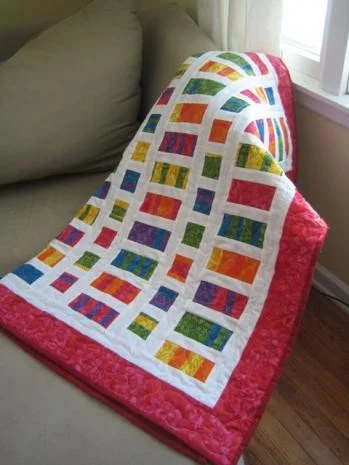
I've been working on this quilt off and on for months. I fought the urge to completely scrap it and start over a couple times, and I'm glad I did. Below is how I made it. It's more of guidelines rather than a pattern, so feel free to ask if you have questions.
[img:1]
Finished size
44.5" x 52" - I tend to make baby quilts larger than crib size, since the babies are only crib size for less than two years. I like to give them things they'll be staining for years.
Supplies
Piecing
- Six fat quarters - I used batiks in red, orange, yellow, green, blue and violet
- 1 yard sashing fabric (white). You might want to get a little extra, to be safe.
- 1/3rd yard border fabric (red)
- Thread and other common quilting notions
Finishing
- 1/2 yard - Binding - I used the same fabric as the backing.
- 1.5 yards 56" fabric - Backing - I used a solid red.
- 48" x 56" Batting
Cutting
Cut each of the fat quarts into strips that vary between 1" and 2.5" at their thickest and thinnest.
[img:2]
Divide each color into thirds. Sew the strips back together, alternating one third with the color prior in the spectrum, one third with the color after, and one third with itself. Continue to sew them together, pressing the seams open, until you have one long strip of fabric.
[img:3]
- Cut this reconstructed piece of fabric into 5" strips, cutting the same directions as the seams.
- Cut each of those strips into pieces that are 2.5"x5"
- From those, select 22 and cut them in half to make 44 2.5" squares - C1
- You will need 60 5" x 2.5" blocks. You should have extras. - C2
From the sashing fabric, cut
- 40 - 1.5" x 2.5" - S1
- 55 - 1.5" x 5" - S2
- 8 - 1.75" x 2.5" - S3
- 10 - 2" x 35.5" - S4
- 2 - 2" x 46" (if you use standard 42" width fabric, you'll need to piece these) - S5
From border fabric, cut
- 2 - 3.5" x 38.5"
- 2 - 3.5" x 40.5"
- 2 - 3.5" x 12.5"
Piecing
Finishing
Create 4 short rows and 5 tall rows, pressing the seams.
Short row (SR):
S3 - C1 - S1 - C1 - S1 - C1 - S1 - C1 - S1 - C1 - S1 - C1 - S1 - C1 - S1 - C1 - S1 - C1 - S1 - C1 - S1 - C1 - S3
Long row (LR):
C2 - S2 - C2 - S2 - C2 - S2 - C2 - S2 - C2 - S2 - C2 - S2 - C2 - S2 - C2 - S2 - C2 - S2 - C2 - S2 - C2 - S2 - C2
Alternate color rows and sashing as follows. Press seams.
- S4
- LR
- S4
- SR
- S4
- LR
- S4
- SR
- S4
- LR
- S4
- SR
- S4
- LR
- S4
- SR
- S4
- LR
- S4
Sew the S5 pieces to the side.
[img:4]
Sew short border to the top and bottom. Press seams. Sew remaining border pieces to the left and right. Press seams.
Quilt and bind.
[img:5]

I've been working on this quilt off and on for months. I fought the urge to completely scrap it and start over a couple times, and I'm glad I did. Below is how I made it. It's more of guidelines rather than a pattern, so feel free to ask if you have questions.
Finished size
44.5" x 52" - I tend to make baby quilts larger than crib size, since the babies are only crib size for less than two years. I like to give them things they'll be staining for years.
Supplies
Piecing
- Six fat quarters - I used batiks in red, orange, yellow, green, blue and violet
- 1 yard sashing fabric (white). You might want to get a little extra, to be safe.
- 1/3rd yard border fabric (red)
- Thread and other common quilting notions
Finishing
- 1/2 yard - Binding - I used the same fabric as the backing.
- 1.5 yards 56" fabric - Backing - I used a solid red.
- 48" x 56" Batting
Cutting
Cut each of the fat quarts into strips that vary between 1" and 2.5" at their thickest and thinnest.
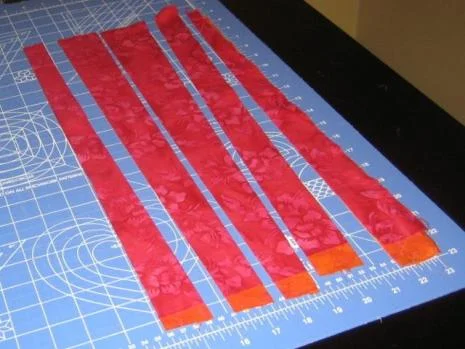
Divide each color into thirds. Sew the strips back together, alternating one third with the color prior in the spectrum, one third with the color after, and one third with itself. Continue to sew them together, pressing the seams open, until you have one long strip of fabric.

- Cut this reconstructed piece of fabric into 5" strips, cutting the same directions as the seams.
- Cut each of those strips into pieces that are 2.5"x5"
- From those, select 22 and cut them in half to make 44 2.5" squares - C1
- You will need 60 5" x 2.5" blocks. You should have extras. - C2
From the sashing fabric, cut
- 40 - 1.5" x 2.5" - S1
- 55 - 1.5" x 5" - S2
- 8 - 1.75" x 2.5" - S3
- 10 - 2" x 35.5" - S4
- 2 - 2" x 46" (if you use standard 42" width fabric, you'll need to piece these) - S5
From border fabric, cut
- 2 - 3.5" x 38.5"
- 2 - 3.5" x 40.5"
- 2 - 3.5" x 12.5"
Piecing
Finishing
Create 4 short rows and 5 tall rows, pressing the seams.
Short row (SR):
S3 - C1 - S1 - C1 - S1 - C1 - S1 - C1 - S1 - C1 - S1 - C1 - S1 - C1 - S1 - C1 - S1 - C1 - S1 - C1 - S1 - C1 - S3
Long row (LR):
C2 - S2 - C2 - S2 - C2 - S2 - C2 - S2 - C2 - S2 - C2 - S2 - C2 - S2 - C2 - S2 - C2 - S2 - C2 - S2 - C2 - S2 - C2
Alternate color rows and sashing as follows. Press seams.
- S4
- LR
- S4
- SR
- S4
- LR
- S4
- SR
- S4
- LR
- S4
- SR
- S4
- LR
- S4
- SR
- S4
- LR
- S4
Sew the S5 pieces to the side.

Sew short border to the top and bottom. Press seams. Sew remaining border pieces to the left and right. Press seams.
Quilt and bind.

Snow Day Sock Pattern
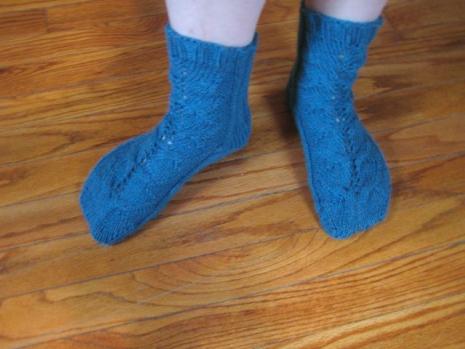
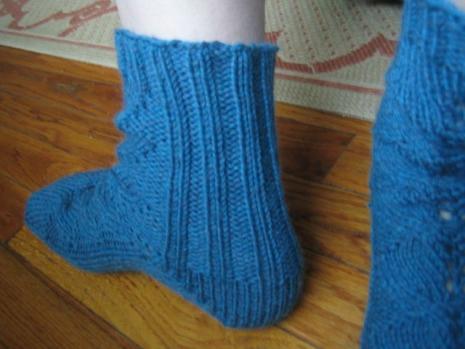
As it gets colder, I'm discovering that normal socks are no match for the coldness of my hardwood floors. Not being much of a slipper person, I made these worsted weight socks. They are too thick to wear with shoes, but they are perfect for keeping my toes warm around the house.
These socks are knit toe up with a short row heel using the magic loop method. They are a very fast knit - I'm a slow knitter and completed them in less than a week. The pattern includes charted and written instructions.
[img:1]
Thanks to karinamaza, moilulu and LiveIIKnit on Ravelry for helping test.
Size
Adult women's
Gauge
2"x2" in stockinette st = 9.5 sts x 12 rows - it is not necessary to get row gauge.
Materials
- US size 5 (3.75 mm) 40" circular needles
- 90 gr Cascade 220 worsted
- Cable needle
- Tapestry needle
Notes
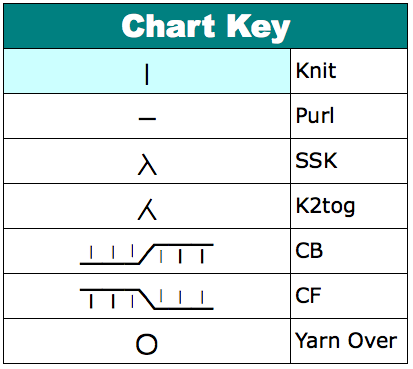
- W&T - Wrap and turn - slip the stitch to the right needle, bring yarn to front, slip stitch to left needle.
- CF - Cable front - Slip 3 sts to cable needle, hold to front, k3, k3 from cable needle
- CB - Cable back - Slip 3 sts to cable needle, hold to back, k3, k3 from cable needle
- YO - yarn over
- SSK - Slip slip knit
- K2tog - Knit two sts together
[img:2]
[img:3]
Chart
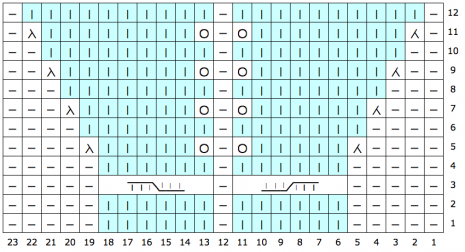
- Row 1 - P5 k6 p1 k6 p5
- Row 2 - P5 k6 p1 k6 p5
- Row 3 - P5 CB p1 CF p5
- Row 4 - P5 k6 p1 k6 p5
- Row 5 - P4 k2tog k5 YO p1 YO k5 SSK p4
- Row 6 - P4 k7 p1 k7 p4
- Row 7 - P3 k2tog k6 YO p1 YO k6 SSK p3
- Row 8 - P3 k8 p1 k8 p3
- Row 9 - P2 k2tog k7 YO p1 YO k7 SSK p2
- Row 10 - P2 k9 p1 k9 p2
- Row 11 - P1 k2tog k8 YO p1 YO k8 SSK p1
- Row 12 - P1 k10 p1 k10 p1
[img:4]
Toe
Create a slip knot. Cast on 24 sts in addition to the slip knot (12 on needle, 12 on cable) using Figure 8 cast on.
Knit even one round. Do not knit the slip stitch. When you come to it, just drop it off and pull the slip knot out.
- Increase row: K1, m1, k until one st remains on needle, m1, k1. Repeat on other needle.
- Even row: K all stitches.
Alternate increase row and even row until you have 44 sts total, 22 on each needle.
- First needle - K21, m1, k1 (23 sts)
- Second needle - K1, m1, k until one st remains on needle, m1, k1. (24 sts; 47 stitches total)
K one round.
Foot
Work chart on first needle, k second needle.
Continue until sock measures 2.5" less than the length of the foot (approximately 3 repeats), stopping at the beginning of needle 2. Remember to note the last row worked.
Final row of chart worked: _____
Heel
The heel is a short row heel worked across the 24 stitches on the second needle.
- Row 1 – Knit to last stitch. W&T
- Row 2 - Purl to last stitch. W&T
- Row 3 – K to one stitch before the wrapped stitch. W&T
- Row 4 - P to one stitch before the wrapped stitch. W&T
Repeat rows three and four 5 more times. There will be 7 wrapped stitches on each end.
Now we need to pick up the wrapped stitches.
- Row 1 – K to the first wrapped stitch. Pick up the wrap around the stitch, place it on the left needle, and knit the wrap and the stitch together. Turn. Twisting the wrap will keep it tight and neat.
- Row 2 – P to the first wrapped stitch. Pick up the wrap around the stitch, place it on the left needle, and knit the wrap and the stitch together. Turn.
Repeat until all the wrapped stitches have been worked.
Leg
- Needle 1 - Continue working chart from the row you noted above
- Needle 2 - P1 [k2 p2] 5 times, k2 p1
Continue working chart on needle 1 and ribbing on needle 2 until there are six repeats of the chart.
Ribbing
- Needle 1 - P1 [k2 p2 k2 p2 k2 p1] 2 times
- Needle 2 - P1 [k2 p2] 5 times, k2 p1
Repeat until ribbing measures one inch.
Loosely cast-off and weave in ends.
[img:5]
As it gets colder, I'm discovering that normal socks are no match for the coldness of my hardwood floors. Not being much of a slipper person, I made these worsted weight socks. They are too thick to wear with shoes, but they are perfect for keeping my toes warm around the house. These socks are knit toe up with a short row heel using the magic loop method. They are a very fast knit - I'm a slow knitter and completed them in less than a week. The pattern includes charted and written instructions.
Thanks to karinamaza, moilulu and LiveIIKnit on Ravelry for helping test.
Size
Adult women's
Gauge
2"x2" in stockinette st = 9.5 sts x 12 rows - it is not necessary to get row gauge.
Materials
- US size 5 (3.75 mm) 40" circular needles
- 90 gr Cascade 220 worsted
- Cable needle
- Tapestry needle
Notes
- W&T - Wrap and turn - slip the stitch to the right needle, bring yarn to front, slip stitch to left needle.
- CF - Cable front - Slip 3 sts to cable needle, hold to front, k3, k3 from cable needle
- CB - Cable back - Slip 3 sts to cable needle, hold to back, k3, k3 from cable needle
- YO - yarn over
- SSK - Slip slip knit
- K2tog - Knit two sts together
Chart
- Row 1 - P5 k6 p1 k6 p5
- Row 2 - P5 k6 p1 k6 p5
- Row 3 - P5 CB p1 CF p5
- Row 4 - P5 k6 p1 k6 p5
- Row 5 - P4 k2tog k5 YO p1 YO k5 SSK p4
- Row 6 - P4 k7 p1 k7 p4
- Row 7 - P3 k2tog k6 YO p1 YO k6 SSK p3
- Row 8 - P3 k8 p1 k8 p3
- Row 9 - P2 k2tog k7 YO p1 YO k7 SSK p2
- Row 10 - P2 k9 p1 k9 p2
- Row 11 - P1 k2tog k8 YO p1 YO k8 SSK p1
- Row 12 - P1 k10 p1 k10 p1

Toe
Create a slip knot. Cast on 24 sts in addition to the slip knot (12 on needle, 12 on cable) using Figure 8 cast on. Knit even one round. Do not knit the slip stitch. When you come to it, just drop it off and pull the slip knot out.
- Increase row: K1, m1, k until one st remains on needle, m1, k1. Repeat on other needle.
- Even row: K all stitches.
Alternate increase row and even row until you have 44 sts total, 22 on each needle.
- First needle - K21, m1, k1 (23 sts)
- Second needle - K1, m1, k until one st remains on needle, m1, k1. (24 sts; 47 stitches total)
K one round.
Foot
Work chart on first needle, k second needle.
Continue until sock measures 2.5" less than the length of the foot (approximately 3 repeats), stopping at the beginning of needle 2. Remember to note the last row worked.
Final row of chart worked: _____
Heel
The heel is a short row heel worked across the 24 stitches on the second needle.
- Row 1 – Knit to last stitch. W&T
- Row 2 - Purl to last stitch. W&T
- Row 3 – K to one stitch before the wrapped stitch. W&T
- Row 4 - P to one stitch before the wrapped stitch. W&T
Repeat rows three and four 5 more times. There will be 7 wrapped stitches on each end. Now we need to pick up the wrapped stitches.
- Row 1 – K to the first wrapped stitch. Pick up the wrap around the stitch, place it on the left needle, and knit the wrap and the stitch together. Turn. Twisting the wrap will keep it tight and neat.
- Row 2 – P to the first wrapped stitch. Pick up the wrap around the stitch, place it on the left needle, and knit the wrap and the stitch together. Turn.
Repeat until all the wrapped stitches have been worked.
Leg
- Needle 1 - Continue working chart from the row you noted above
- Needle 2 - P1 [k2 p2] 5 times, k2 p1
Continue working chart on needle 1 and ribbing on needle 2 until there are six repeats of the chart.
Ribbing
- Needle 1 - P1 [k2 p2 k2 p2 k2 p1] 2 times
- Needle 2 - P1 [k2 p2] 5 times, k2 p1
Repeat until ribbing measures one inch.
Loosely cast-off and weave in ends.
Knit Monster Baby Booties
Note 2/6/11: I've created a new version of this design with improved construction and more sizes (this version runs small). Find the improved monster booties pattern here.
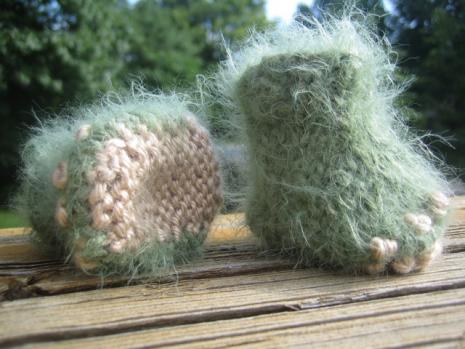
The crochet version of these booties were such a hit that I wrote a pattern for knitting. These booties will fit 0-3 months on a small baby. They are pretty small, so you might want to use larger needles than I did.
Note 2/6/11: I've created a new version of this design with improved construction and more sizes (this version runs small). Find the improved monster booties pattern here. The crochet version of these booties were such a hit that I wrote a pattern for knitting. These booties will fit 0-3 months on a small baby. They are pretty small, so you might want to use larger needles than I did.

Supplies
- Worsted weight yarn for the sole. Caron Simply Soft in Bone.
- Fuzzy yarn for the monster foot. Moda-Dea Dream in Leaf.
- Size 5 dpn
- Tapestry needle
Instructions
Sole
- With worsted yarn, longtail cast on 8.
- Row 1 - 16: stockinette stitch
- Row 17: k2tog k4 k2tog
- Row 18: purl
- Row 19: k2tog k2 k2tog
- Row 20: Cast off purlwise
- Weave in ends
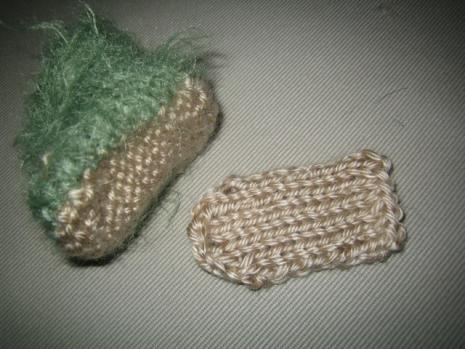
Foot
- Switching to the fuzzy yarn, pick up and knit around the boarder of the sole. Start with the back and spread the stitches across 4 dpns - 6 stitches across the back (flat side), 9 stitches on each side, and 6 across the toe.
- Rows 1 - 8: Knit
- Row 9: k14 k2tog k4 k2tog k8
- Row 10: k14 k2tog k2 k2tog k8
- Row 11: k14 k2tog k2tog k8
- Row 12: k13 k2tog k2tog k7
- Rows 13-18: 1k1p ribbing
- K1-P1 bind off and weave in ends
Claws
I made the claws by tying French Knots with doubled up yarn. I wouldn't use beads or buttons, although they would be cute, due to the choking hazard.
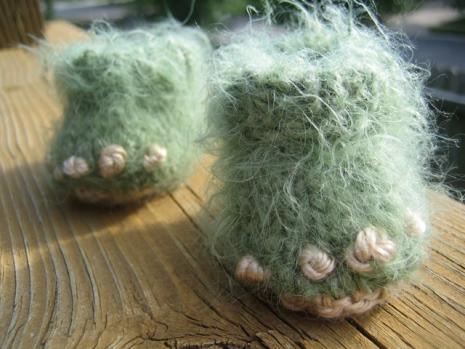
Monster Baby Booty Pattern
[img:1] 
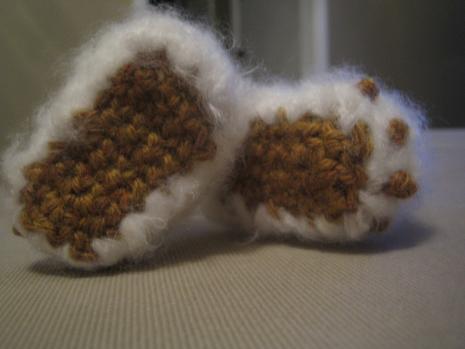
These booties are really quick and easy to crochet. I made this out of yarn in the stash. They don't take much yarn. You could also make them out of green or other great monster colors.
These booties will fit 0-3 months on a small baby. They are pretty small, so you might want to use larger hook than I did.

These booties are really quick and easy to crochet. I made this out of yarn in the stash. They don't take much yarn. You could also make them out of green or other great monster colors.
These booties will fit 0-3 months on a small baby. They are pretty small, so you might want to use larger hook than I did.
Supplies
- Worsted weight yarn for the sole
- Fuzzy yarn for the monster foot. (I lost the label on mine, so I'm not sure what yarn it is, but any novelty yarn should be fine.)
- Size I hook
- Tapestry needle
Instructions
Each turn counts as the first sc for the row.
Sole
With worsted yarn, ch 6.
Row 1: Skip the first two ch (these become the first sc) sc4 (5 total)
Rows 2-9: Turn. sc 4.
Row 10: Turn. dc, tc, dc, sc. Pull yarn through and weave in ends.

Foot
Join the white to the sole at the back corner (not the rounded end). We will sc around the outside of the sole. There will be 4 stitches on the front and back and 6 on each side (a total of 20 stitches). The stitches down the side don't naturally fall in line with the rows in the sole, but you can work them in at an even spacing.
Rows 1 - 3: Ch 2 (the first sc) sc19. Join.
Row 4: Turn. sc 5 (this should bring you to the start of the toe), sc4tog, sc10. Join.
Row 5: Turn. sc 8 (since you were going in the opposite direction, this should also put you at the start of the toe), sc3tog, sc5. Join.
Row 6 & 7: Turn. sc 14. Join. Pull yarn through and weave in ends.
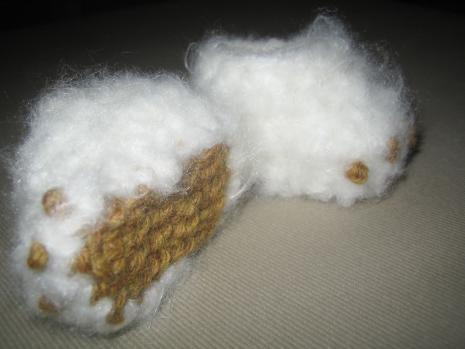
Claws
I made the claws by tying French Knots. I wouldn't use beads or buttons, although they would be cute, due to the choking hazard.